How a chapter is taught
The book splits every chapter into Section A (a story, vocabulary and activities) and Section B (a grammar or skill focus with pair work). That gives a natural rhythm: two classes, then home.
Class 1 · Section A
The teacher opens the Section A deck. The episode plays inside the deck as the story moment, then the deck runs the vocabulary check, story-recall and practice activities from the book pages.
Asset: episode + Section A slidesClass 2 · Section B
The Section B deck re-uses short clips from the episode as prompts ("What is Nova doing?") and drives the grammar point, pair work and presentation activities.
Asset: Section B slides (episode clips)At home · Mission
The chapter's mission unlocks in the game. The child replays the story world, plays 3 mini-games on that chapter's words and grammar, and does the book's speaking task in the game, which earns a passport stamp.
Asset: game mission in the 10 Minute School app. It replaces the book's "make a video" homework.The three assets
What each asset is, its format and how it is built. All three use the canonical character rigs (apps/toonrig/CAST.md), so a character looks and sounds the same in the episode, on the slide and in the game.
1 · Episodes
16:9 · projector2–4 minEnglish- One episode per chapter, telling the Section A story. The book's lines are kept word for word: the activities quiz those exact sentences.
- Each new vocabulary word is tagged on screen as it is spoken, revealed letter by letter, the same mechanic as the idiom shorts.
- The grammar point is acted out, not explained: "MathMan always brushes his teeth", "Nova is washing…".
- Built with the kids-english-toons pipeline (long mode): ElevenLabs voices, lip-sync timed by Rhubarb, subtitles on. Delivered as MP4 so it plays offline in the centres.
2 · Classroom slides
2 decks / chapteranimated, voicedtap to advance- Section A deck: warm-up → episode → vocabulary (6 words, picture + voice) → story recall (true/false, fill blanks) → practice → speaking homework brief.
- Section B deck: recap clip → grammar shown with the characters → interactive practice (tap to match, sort, choose) → pair work and presentation scaffolds.
- Every activity maps to a book page, so the teacher can say "open page 41". Book page numbers sit in each slide's corner.
- Built in Kids Slide Studio (book pages + teacher guide in, deck out, reviewers comment slide by slide). Same engine as "Our English Adventure".
3 · Home game
9:16 · phoneinside the 10 Minute School app8–10 min / mission- One central game, "Shimul Bari: Passport to English". A neighbourhood the child explores as Bhasha, built on the Rooftop Friends engine (walk · jump · talk, voiced, lip-synced).
- 17 missions, one per chapter, each set in that chapter's place (school, market, jungle, Dhanmondi Lake…). It opens with the Student Passport from Chapter 1; every mission earns a stamp.
- Each mission = story moment + 3 mini-games (vocabulary, grammar, comprehension) + 1 speaking task.
- It is the homework: the Echo booth replaces the book's "make a video" task. The child records the speaking sentence in the game, and the teacher hears it.
- Lives in the 10 Minute School app (web game in an in-app webview): the student is already logged in, missions unlock by batch schedule, and progress reaches the teacher. Under 10 MB per mission, works on low-end Android.
Cast: the book already uses our four
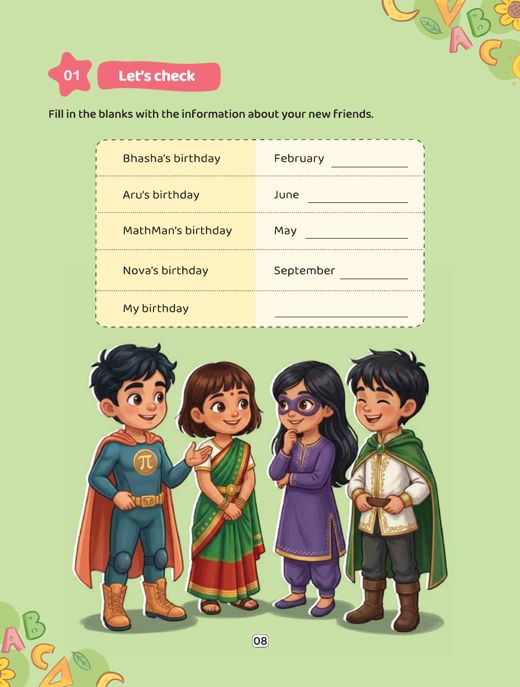
The book's art matches our rigs (Bhasha in her sari, the π superhero, Nova with her mask and wristband, Aru with his green cape), and their powers match our backstories. Locked: he is Ashim in every episode, slide and game line (the printed book still says "MathMan"; teachers bridge it with "Ashim, our MathMan" in Chapter 1). Ages follow our character bible, not the book's profile pages.
Supporting characters to build (about 25): Bhasha's family (mother Lily Zaman, father Ananto Zaman, Uncle Akram, Aunt Misha, cousin Rudra, Grandma Rashida) · Zara (new classmate) · Ms. Saima (teacher) · fruit vendor + rude customer · Nova's mother and father · the land owner + workers · Aru's chickens Moony, Luna, Noodles, Ricky + cat + fox · Rafiq Kaka (lake cleaner) · firefighters · tea seller · Dr. Jahan · traffic police · building guard · Rashida Aunty (househelp) · Rafi (Chapter 16) · Aru's parents · Mithu the parrot · Sultan the dog. Animals and one-scene adults can be simpler side-character packs.
The 17 chapters → episode · slides · mission
Story, vocabulary and grammar are taken from the book. The episode, slide and mission ideas are proposals. Filter by the main character in the story.
Game design: "Shimul Bari: Passport to English"
One world that grows across the semester. Each week a new place opens on the map, matching the chapter taught in class. The Chapter 1 "Student Passport · Republic of Learning" is the progression system: 17 stamps, then the finale.
Ch 1Ch 3Ch 17
Ch 6Ch 8Ch 10Ch 13
Ch 4Ch 7Ch 9
Ch 2Ch 11Ch 12
Ch 5
Ch 15
Ch 14Ch 16
all stamps
Mission template (8–10 min)
| Beat | What happens | Book link |
|---|---|---|
| 1 · Arrive | Walk into the chapter's place; an NPC from the episode asks for help (voiced, lip-synced). | Section A story |
| 2 · Word hunt | Find and tap the 6 vocabulary words hidden in the scene; each says its meaning. | "Vocabulary" box |
| 3 · Grammar game | One mechanic from the catalogue below, themed to the story. | Section B focus |
| 4 · Story check | 3 quick recall questions with picture answers. | True/False, recall |
| 5 · Echo booth | Bhasha's power: the child records the chapter's speaking task (the book's "make a video" prompts) into the mic. The recording goes to the teacher as that week's homework. | Replaces "Make a video" |
| 6 · Stamp | Passport stamp + sticker; the next place appears on the map after the next class. | Student Passport, Ch 1 |
Grammar mechanics catalogue (reusable)
| Mechanic | Teaches | Chapters |
|---|---|---|
| Sort into baskets | can/can't · must/should · good/not good · polite/rude | 1, 4, 5, 7, 16 |
| Meter slider | always / sometimes / never | 2 |
| Deliver it | my / his / her / 's | 3 |
| Place it | in front of · behind · next to · near · between | 6, 9, 14 |
| Compare it | bigger / faster / happier | 8 |
| Time machine | past tense, regular (-ed) and irregular | 10, 11, 17 |
| This or these | this / these · some / many | 9, 11 |
| Ask the right question | what / when / why / how | 13 |
| I spy | present continuous · past continuous | 14, 15 |
| Choose the reply | polite phrases · safe choices online | 7, 16 |
10 mechanics cover all 17 chapters. Build each once, then re-skin it per chapter.
Production: what we build once, and what we build per chapter
Build once (foundation)
- Series bible: a single cast sheet (names, ages, classes, voices) agreed with the book.
- ~25 supporting characters through the toonrig pipeline on gpt-image-2.6 (adults and children full rigs; animals as simpler packs).
- ~20 locations as background plates: home, school (4 rooms), town (5 places), jungle, lake, the big tree, Nova's house, festival scenes. Each is reused across all three assets: the episode background, the slide scene and the game level.
- Episode template: 16:9 classroom format, vocabulary tags, subtitles, a chapter title card and an end card with the 6 words.
- Game shell: map, passport, save progress, the 10 grammar mechanics, the Echo booth.
Per chapter (repeatable, about 1 week)
| Step | Output | Tool |
|---|---|---|
| Script | Book story as a screenplay, lines word for word, plus vocabulary and grammar beats | screenplay → planner (long mode) |
| Episode | Voices, lip-sync, render, QA, MP4 | kids-english-toons |
| Slides A + B | Book pages + teacher guide → 2 decks, reviewer comments | Kids Slide Studio |
| Mission | Fill in the mission template: NPC lines, words, mechanic config | game data file + voices |
| Review | Teacher + Kids English content team sign-off on all three | per-slide comments |
Recommended first build: Chapter 5 "Why rules matter"
The chapter that needs the fewest new characters: zero. The whole Section A story uses only Bhasha, Ashim, Nova and Aru, and it has the most visual action of any chapter (a jungle, a slip, a splash, a rescue). It proves all three assets without waiting on the character pipeline.
Episode 5 · The Jungle Trip
0 new characters~3 min · 16:9- Cast: the four friends only. Bhasha's colourful bird is a prop, not a character.
- Places: jungle path, the bird's branch + muddy puddle, the camp (3 plates from one jungle set).
- Beats (book lines word for word): excited start → Ashim writes the 4 rules → Nova leads with the map → Bhasha follows the bird, slips, splash, "Help!" → Nova: "We must stay together" → rescue → camp: "We should follow rules to stay safe and have fun together."
- On-screen words: safe, follow, trip, jungle, leader. "Must" and "should" are highlighted when spoken.
Slides 5A + 5B
book p. 40–50teacher guide Ch 5- 5A: warm-up ("What is a rule?") → episode → 5 vocabulary words → true/false (6 items from the book) → good rule or bad rule (green/red) → should or must → homework brief.
- 5B: Ashim's classroom puzzle scene (from the episode set) → rules at home vs school → problem → rule with should/must → "play with a ball" game → rule poster.
Mission 5 · Jungle Trip
8–10 minhomework- Arrive: camp. Ashim holds up the rule paper and asks the child to help lead the trip.
- Word hunt: find the 5 words on signs and objects along the jungle path.
- Grammar game, "Must or should?": at each fork a choice ("You ___ stay together"). The right answer opens the path; a wrong one makes Bhasha wander toward the bird.
- Story check: 3 picture questions (who led, what Bhasha saw, what happened).
- Echo booth (the homework): "Rules at my home": the child records three rules using must/should; the teacher hears it.
- Stamp: the first passport stamp is the Jungle badge.
Runner-up: Chapter 12 "Seasons I love" (also zero new characters, but 4 season backgrounds and less action). Both run on the existing Rooftop Friends game engine (walk · jump · talk, voiced, lip-synced).
Timeline (proposal)
Pilot one chapter end to end before scaling, then run two chapters a week. These are estimates to agree, not commitments.
Decide & set up
- Cast + naming locked ✓
- App team: webview, mic, login, upload interface
- Get the teacher guide for each chapter
- Location list + supporting-character list
Pilot: Chapter 5
- Episode "The Jungle Trip" (0 new characters)
- Decks 5A + 5B
- Game shell + passport + Mission 5
- Test in one class + 10 homes
Scale: 2 chapters / week
- The other 16 chapters, in book order
- Characters built just in time for their chapter
- Each chapter's 3 assets ship together
Finale & polish
- Finale party mission
- Teacher progress view (if approved)
- Offline episode pack for centres
Decisions (locked 6 Nov)
- Name: Ashim everywhere (episodes, slides, game). The printed book says "MathMan"; Chapter 1 slides bridge it ("Ashim, our MathMan").
- Ages: from the character bible: Bhasha 8, Ashim 8, Nova 9, Aru 8. Episodes don't state school classes (the book's profiles differ).
- Language: English dialogue at book level (no Banglish). Bangla subtitles optional, off by default.
- Homework: the game mission replaces the book's "make a video" homework. The Echo booth recording is that week's speaking submission.
- Home: the game lives in the 10 Minute School app (in-app webview). The app handles login, unlocks missions by batch schedule and reports progress and recordings to teachers.
- Teacher guides: available for every chapter. Kids Slide Studio takes the book pages + guide per chapter. Needed: the guide files (please share the folder).
What the decisions add to the build
- App team dependency: in-app webview with microphone permission (Android + iOS), a login hand-off to the game, and an endpoint that stores recordings and progress against the student's batch.
- Teacher side: a simple list per batch (who finished the mission + play each recording). It fits ClassroomOS, the universal ops platform, rather than a new tool.
- Consent and storage: children's voice recordings need parent consent in the app, a retention period and access limited to the batch teacher.
Risks
| Risk | Why it matters | Mitigation |
|---|---|---|
| Supporting-character load | About 25 new characters; each full rig is the slowest part of the pipeline. | Build just in time per chapter; give one-scene adults and animals simpler packs; reuse the market and street crowd across chapters. |
| Religious festivals (Ch 10) | Pohela Boishakh, Eid, Christmas and Durga Puja shown together; any depiction error is a public problem. | Respectful, non-ritual scenes (food, clothes, family, decorations); content review sign-off before render. |
| Script drift from the book | Activities quiz exact story sentences; a paraphrased episode breaks the class. | Book lines are word for word (planner rule already exists); QA every line against the OCR text. |
| Kids' speech recognition | Young voices with a Bangla accent get misjudged, which demotivates. | The recording is homework the teacher hears, so the game never "fails" a child: it only checks that something was said, then submits. |
| App integration | Missions depend on the app team (webview, mic permission, login hand-off, recording upload). | Agree the interface in Week 1; the pilot runs as a web link with a test login until the app release lands. |
| Device and data at home | Low-end Android phones and limited data. | < 10 MB per mission, lazy loading, WebP and short audio; test on a cheap device in the pilot. |
| Classroom playback | Centre internet can't be relied on. | Episodes as downloaded MP4s, and decks as single self-contained HTML files (the existing build already does this). |